
Product families

Quick links
Headquarters
Sign up for our newsletter to receive updates directly in your inbox
By registering I agree to TreCe’sdata protection policy.
We support the important work of


Offices generate more waste than most people expect. Paper, cardboard, coffee grounds, plastic packaging, old electronics. It keeps coming. The question isn’t whether to sort your waste; it’s how to make it work in practice: easy for staff, legally compliant, and presentable enough to keep in plain sight. This guide covers everything you need to get started or level up your office waste sorting in 2026.
Sustainability has shifted from a nice-to-have to something companies are actually held accountable for. Customers, employees, and investors want to see that businesses take responsibility for their environmental impact, and how you handle waste is often the most visible sign of whether you’re serious about it. Good waste sorting reduces what goes to incineration, cuts waste management costs, and gets more material back into the cycle. It also sends a clear message internally: an office that makes doing the right thing easy is one that actually cares. At TreCe, we see waste sorting as a natural part of the interior, just as considered as the furniture and lighting.
Swedish law requires businesses to separate waste for material recycling, on the same basis as households. Under the Waste Ordinance (2020:614) and the Producer Responsibility Regulation for Packaging (2022:1274), every business must separate its packaging waste and store it separately from other waste, ideally where the waste is generated. Since 1 January 2024, there are also requirements to separate and collect bio-waste, including food waste, from both households and businesses (Waste Ordinance, Chapter 3). By 1 January 2027, all municipalities must have introduced kerbside collection of paper, plastic, metal, and glass from households and co-located businesses, which makes now a good time to review your routines.
In practice, most offices need to sort at least these waste fractions:
Note: requirements can vary by municipality, business size, and your agreement with your waste contractor. Check with your municipality and waste contractor before settling on the number of streams.
Sources: Swedish Environmental Protection Agency, Packaging waste from businesses (naturvardsverket.se/vagledning-och-stod/producentansvar/producentansvar-for-forpackningar/forpackningsavfall-fran-verksamheter/), Requirements for separate collection of bio-waste (naturvardsverket.se/vagledning-och-stod/avfall/krav-pa-separat-insamling-av-bioavfall/) And Kerbside collection (naturvardsverket.se/vagledning-och-stod/producentansvar/producentansvar-for-forpackningar/kommuners-insamling-av-forpackningsavfall-fran-hushall-och-vissa-verksamheter/fastighetsnara-insamling/). Retrieved 2026-08-18.
A waste sorting system that lasts takes some groundwork. Here are five steps to get there.
Start by understanding what you’re actually throwing away. Do a simple waste audit over one to two weeks: which fractions are generated, in what quantities, and where in the office? An office with a lot of deliveries will produce more corrugated cardboard and plastic; one with a large lunch room will have more food waste. The audit tells you how many bins you need and what sizes.
Work from the legal requirements and your audit. Most offices land somewhere between four and eight fractions. Fewer fractions are easier to maintain but sort less; more fractions give better recycling rates but need more space and clearer signage. Pick a level you can keep consistent. A half-hearted eight-fraction setup will always underperform a well-run four-fraction one.
Location determines whether the system gets used. Put waste sorting where the waste is generated and where people already move: by the coffee machine, in the lunch room, near printers and copiers, and at the entrance. A well-placed central station combined with smaller bins near workstations works best. Don’t hide the sorting away in a corner. Out of sight means out of use.
Unclear signage is the most common cause of sorting errors. Use clear, consistent symbols and colours, ideally following Avfall Sverige’s national labelling system so staff recognise them from home. Add short examples of what goes where: “milk cartons here,” “plastic film there.” When it’s the same everywhere, sorting becomes intuitive.
The setup doesn’t solve it. Behaviour does. Brief people when new routines are introduced, explain why you’re sorting and what it leads to, and consider appointing an environmental rep to keep the topic alive. Share results: how much residual waste has gone down, how much has been recycled. Visible progress keeps motivation up.

The number of fractions determines both recycling rate and how much room you need. A good starting point is to focus on the fractions that make up the largest volume at your office and build from there. A small office can often manage with paper, plastic, food waste, and residual waste. A larger office with a reception, lunch room, and storage area benefits from a full setup with separate bins for cardboard, metal, glass, and returnable cans. Think in modules: a system that can expand as your needs grow saves both money and hassle down the line.
The natural sorting points in most offices are the lunch room and kitchenette (food waste, packaging, returnables), near printers and copiers (paper and cardboard), at the entrance and reception (incoming post, junk mail, residual waste), and a central station for the larger fractions. A central station combined with smaller bins closer to workstations keeps the barrier to sorting as low as possible. Make sure bins are also easy for cleaning staff to empty. If that doesn’t work, the whole system falls apart at the last step.
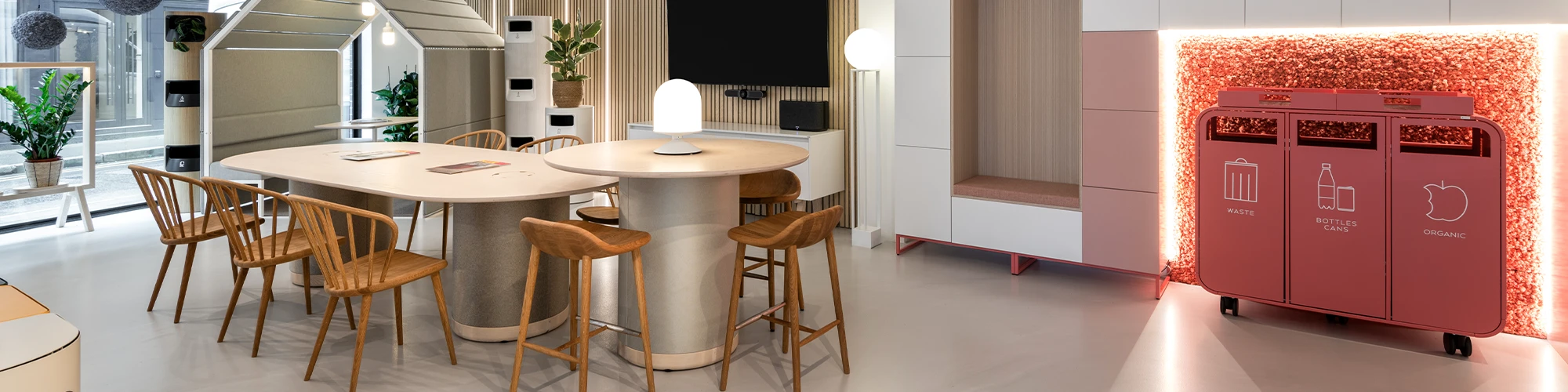
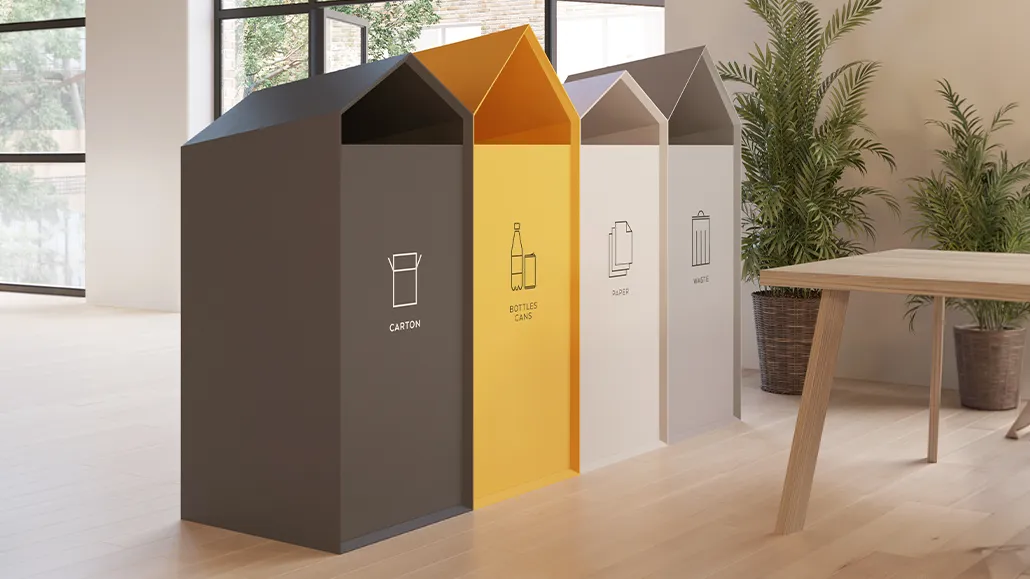
There’s a stubborn assumption that waste bins have to be bulky and ugly. They don’t. When recycling furniture is designed with the same care as the rest of the interior, it adds to the room instead of detracting from it. Good design also improves sorting rates – well-designed, clearly labelled bins that are easy to use encourage the right behaviour. At TreCe, we always start with the room: material, colour, and form should work with the character of the office, while the function holds up in every detail. Waste sorting should be just as considered as the rest of the interior.
Well-meaning offices tend to stumble on the same things: too few bins or unclear labelling, sorting tucked away where nobody sees it, bins in the wrong size that either overflow or sit empty, and routines that never get followed up. We go into the most common pitfalls in a separate article, but the basic rule is simple: make it easy to do the right thing, and check in regularly.

TreCe has been developing recycling and storage solutions for offices and public spaces for decades, with design and sustainability at the core. Our range covers everything from individual, well-formed bins to complete, modular stations that grow with your business. Explore our solutions for office waste sorting, browse the full recycling range, or read more about how we work with environmental responsibility. If you’re looking for inspiration on making sorting a natural part of your interior, we’ve gathered ideas in a separate article.
Yes. Under the Waste Ordinance (2020:614), businesses are required to separate waste for material recycling, on the same basis as households. Source: Swedish Environmental Protection Agency. The specific fractions and routines required can vary by municipality and type of business — check with your municipality and waste contractor.
Most offices land between four and eight. Start from the legal requirements and a waste audit, then choose a level you can maintain consistently.
Where the waste is generated and where people move: lunch rooms, near printers, at the entrance, and as a central station. The lower the barrier, the higher the sorting rate.
No. With thoughtful design, sorting furniture becomes part of the interior and actually improves sorting rates, since well-designed and clearly labelled bins encourage the right behaviour.


Good office waste sorting is as much about placement, signage, and routines as it is about the bins themselves. Legal requirements set the baseline – packaging waste and food waste must be sorted separately – but what determines whether the system works day to day is how easy it is to use. Start with a waste audit, settle on a number of fractions you can maintain consistently, place stations where the waste actually happens, and sign everything the same way. Involve staff and follow up on the results. If you also choose solutions designed to be on display, waste sorting becomes part of the interior rather than something to hide – and your sorting rates will reflect it. Always confirm the exact requirements with your municipality and waste contractor before settling on the number of fractions.
Connect with us
Great choices with a focus on sustainability
Dive into our diverse palette of standard colors and customize your space.
Product families
Quick links
Headquarters
Sign up for our newsletter to receive updates directly in your inbox
By registering I agree to TreCe’sdata protection policy.
We support the important work of

 7 common office recycling mistakes (and how to avoid them)